
Industrial dust filter: Ηow to choose the right baghouse filter for your installation
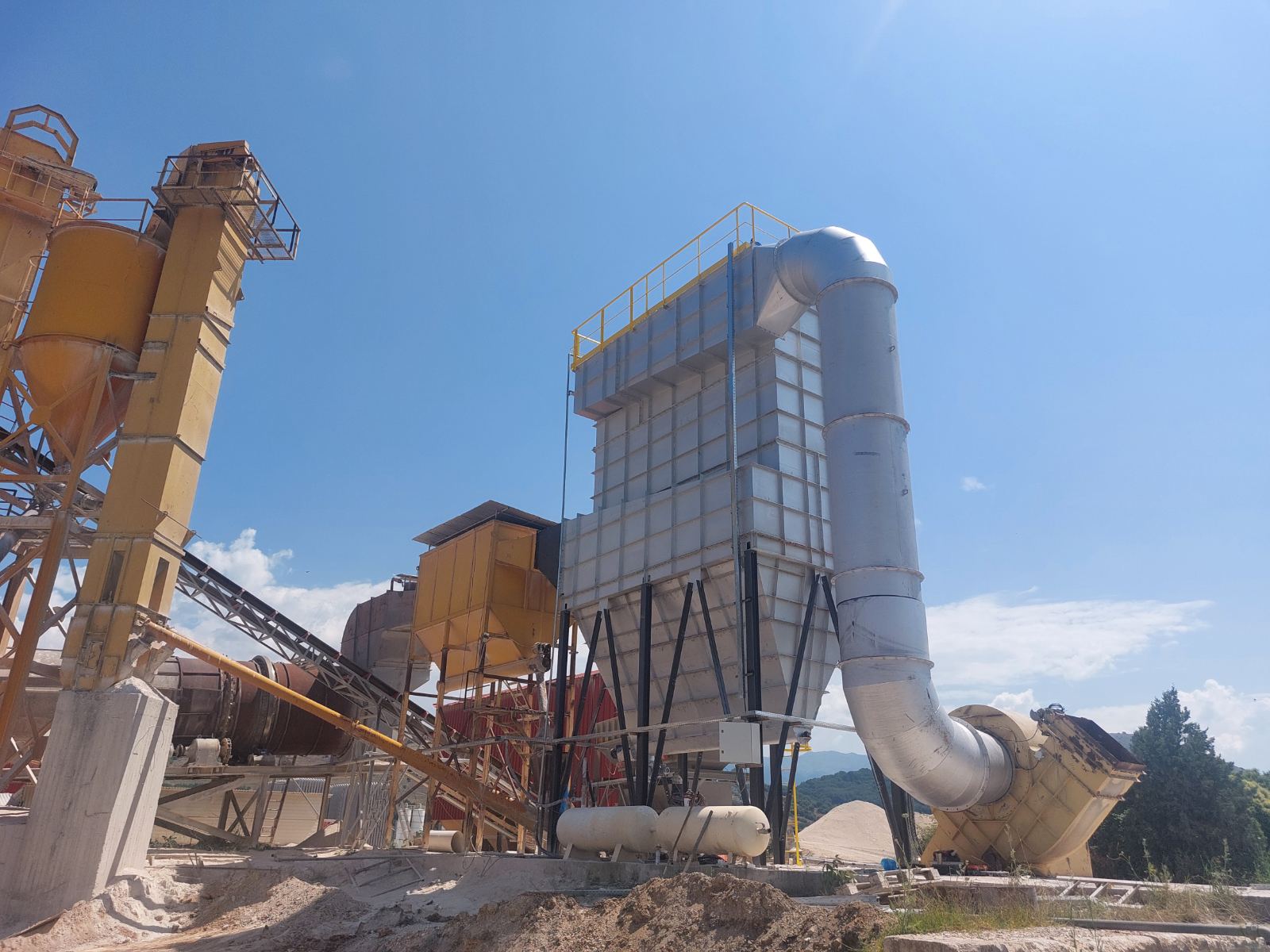
Dust in an industrial facility isn't just a housekeeping issue. It's a matter of emissions compliance, personnel safety, and ultimately, operating cost. A poorly engineered dust collection system means frequent breakdowns, higher compressed air consumption, and filter bags that need replacing far more often than they should.
Self-cleaning baghouse filters are today the most widely used solution for industrial dust collection, and not by accident. They combine reliability, relatively low maintenance cost, and adaptability to nearly any application. The difference between a system that runs trouble-free for years and one that becomes a constant headache almost always comes down to how carefully each application was engineered from the start.
How an industrial baghouse filter works
The operating principle is simple in theory, but its effectiveness depends entirely on correct sizing. Here's what happens, step by step:
- Capture: dust-laden air passes through the filter elements (filter bags, cartridges, or pocket-type media). Particles are captured on the outer surface while clean air passes through.
- Clean air discharge: the air, now free of dust, exits through the outlet of the unit.
- Pulse cleaning: at regular intervals, controlled by the pulse controller, compressed air is fired into the inside of the filter bags through dedicated nozzles.
- Dust removal: the sharp shock of the compressed air pulse dislodges dust from the outer surface of the bags. The dust falls into the hopper, from where it's discharged via a screw conveyor, rotary airlock valve, or other suitable device.
The differential pressure gauge is the system's vital sign monitor: it measures the pressure difference between the clean and dirty sides of the filter. This reading determines when the filter bags need replacing, keeping the baghouse reliably at full operating capacity at all times.
Four main types of baghouse filters: which one fits your application
There's no single "best" filter. There's the right filter for your specific dust, available space, and operating conditions. Here are the four main categories:
Rectangular (panel) filters
The most widely used option in industry, and for good reason. They can be built in virtually any dimension and filtration area, adapting to your requirements rather than limiting them. Filter bags are available in a wide range of technical fabrics, selected according to dust type and operating conditions: temperature, humidity, chemical composition. Best suited for: general-purpose applications where you need flexibility in dimensions and filtration area.
Round (cylindrical) filters
Typically used for smaller dust collection airflows. Their key advantage is the absence of corners; there are no "dead zones" where dust can build up, which matters when handling sticky dust or materials that don't flow easily. They also withstand higher vacuum levels without requiring special structural reinforcement. Best suited for: high-vacuum applications, explosion-protected installations (ATEX), pneumatic conveying systems, and sticky or poor-flowing dusts.
Cartridge filters
Smaller external footprint for a given filtration area, ideal where space is tight. They do, however, require careful engineering: the pleated surface of the filter element makes dust release more difficult. In many cases this rules out their use entirely; in others it requires a particularly low air-to-cloth ratio. Best suited for: installations with limited space, provided the dust characteristics and airflow allow it; correct engineering is critical here.
Pocket filters
Suitable where headroom is limited, since the filter elements are replaced horizontally from the front; no vertical clearance needed for removal. In exchange, they require a comparatively larger filtration area for a given airflow than round bag filters, which must be accounted for correctly at the design stage. Best suited for: low-headroom spaces, with careful attention to the air-to-cloth ratio during design.
Filter media materials: which one fits your dust
The filter type is only half the decision. The other half, equally critical, is the filter bag material, determined by operating temperature, humidity, and the chemical composition of the dust or gas stream. A mistake in material selection doesn't show up immediately; it appears months later as premature wear, rising pressure drop, or outright filter failure.
- Polypropylene (PP), up to ~90°C. Very good resistance to acids and alkalis. Suited for: general industrial use, humid or chemically aggressive environments at low temperature.
- Polyester, up to ~130–150°C. Moderate resistance; prone to hydrolysis in humid conditions. Suited for: general industrial dust collection, woodworking, food processing; the most common economical choice.
- Aramid (Nomex), up to ~200°C. Good, stable under temperature fluctuations. Suited for: high-temperature applications with variable conditions; foundries, metalworking.
- PPS (Ryton), up to ~190°C. Very good in acidic, humid environments. Suited for: boiler flue gas, power generation with sulfur-bearing fuels.
- Polyimide (P84), up to ~240°C. Good against acids and alkalis (pH 2–12). Suited for: cement plants, incineration facilities, very high-temperature applications with chemical exposure.
- Fiberglass, up to ~250°C. Good, but sensitive to mechanical flexing. Suited for: extreme temperatures where other fabrics would melt; requires careful handling due to increased brittleness.
- PTFE (Teflon), up to ~250°C. Excellent, near-inert to most chemicals. Suited for: the most demanding applications: aggressive chemicals, pharmaceuticals, where the cost is justified by longer service life.
A practical rule of thumb: the more demanding the conditions (temperature, chemical exposure, humidity), the higher the initial material cost, but often the lower the total cost of ownership, due to fewer replacements and less downtime. The right choice always depends on your specific application, not general rules.
You need engineering, not just equipment
As you've seen, choosing the right filter type depends on several parameters at once: dust type, available space, operating conditions, safety requirements. Getting this wrong at the selection stage translates into years of maintenance headaches. The engineers at PM Engineering are ready to assess your dust collection needs and propose the system that actually fits your application, not a generic one-size-fits-all solution.
Contact us to discuss your installation.